Category
page 1"Related ethnic groups" needing confirmation

Arabs
Arabs () are an ethnic group mainly inhabiting the Arab world in West Asia and North Africa. A significant Arab diaspora is present in various parts of the world. Before the spread of Arabic language in the wake of the Arab conquests, "Arab" largely referred to the Semitic inhabitants—both settled and nomadic—of the Arabian Peninsula and the Syrian Desert. In modern usage, it includes people from across the Greater Middle East that share Arabic as a native language.

Russians
Russians ( ) are an East Slavic ethnic group native to Eastern Europe. Their mother tongue is Russian, the most spoken Slavic language. The majority of Russians adhere to Orthodox Christianity, ever since the Middle Ages. By total numbers, they compose the largest Slavic and European nation.

Kurds
Kurds (), or the Kurdish people, are an Iranian ethnic group from West Asia. They are indigenous to Kurdistan, which is a geographic region spanning southeastern Turkey, northwestern Iran, northern Iraq, and northeastern Syria. Consisting of 30–45 million people, the global Kurdish population is largely concentrated in Kurdistan, but significant communities of the Kurdish diaspora exist in parts of West Asia beyond Kurdistan and in parts of Europe, most notably including: Turkey's Central Anatolian Kurds (these spread through Eastern Anatolia in 1923 following the Armenian genocide in what was

Tatars
thumb|upright=1.4|Share of Tatars in regions of Russia, 2010 census

Uyghurs
The Uyghurs, alternatively spelled Uighurs, Uygurs or Uigurs, are a Turkic ethnic group originating from and culturally affiliated with the general region of Central Asia and East Asia. They speak the Uyghur language, which is a Karluk Turkic language sharing the same origin with the Uzbek language, descended from the Karakhanid language and Chagatai language. The Uyghurs are recognized as the titular nationality of the Xinjiang Uyghur Autonomous Region in Northwest China. They are one of China's 55 officially recognized ethnic minorities.

Azerbaijanis
Azerbaijanis (; , ), Azeris or Azerbaijani Turks (, ) are a Turkic ethnic group living mainly in the Azerbaijan region of northwestern Iran and the Republic of Azerbaijan. They are the largest ethnic group in the Republic of Azerbaijan and the second-largest ethnic group in neighboring Iran and Georgia. They speak the Azerbaijani language, belonging to the Oghuz branch of the Turkic languages, and predominantly practice Shia Islam.

Armenians

Turks
Turkic ethnic group
.svg)
Slavs
The Slavs or Slavic people are groups of people who speak Slavic languages. Slavs are geographically distributed throughout the northern parts of Eurasia; they predominantly inhabit Central Europe, Eastern Europe, Southeastern Europe, and Northern Asia, though there is a large Slavic minority scattered across the Baltic states and Central Asia, and a substantial Slavic diaspora in the Americas, Western Europe, and Northern Europe.
alt=|thumb|Contemporary map of the Slavic people|Slavic speaking countries of [[Europe.

English people
citizens of England

Kazakhs
The Kazakhs are a Turkic ethnic group native to Central Asia and Eastern Europe. They share a common culture, language and history that is closely related to those of other Turkic peoples. The majority of ethnic Kazakhs live in their transcontinental nation state of Kazakhstan.

Han Chinese people
ethnic group native to China Central Plain
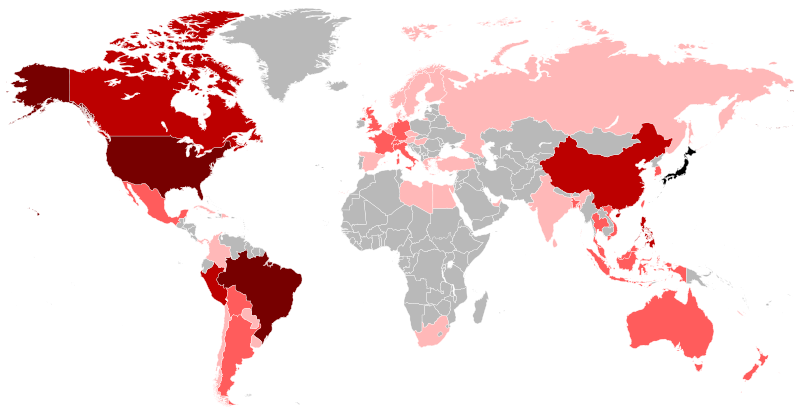
Japanese people
East Asian ethnic group native to Japan

Pashtuns
Pashtuns are an Iranian ethnic group primarily residing in southern and eastern Afghanistan and northwestern Pakistan. They were historically referred to as Afghans even into the 1970s, although the constitution of 1923 began the use of 'Afghans' as a demonym for all citizens of the Kingdom, regardless of their ethnic group, to create an Afghan national identity.
Poles
West Slavic ethnic group

Ainu people
ethnic group in Japan and Russia
.jpg)
Uzbeks
The Uzbeks () are a Turkic ethnic group native to Central Asia, being the largest Turkic ethnic group in the area. They comprise the majority population of Uzbekistan, next to Tajiks and Karakalpak minorities, and also form minority groups in Afghanistan, Tajikistan, Kyrgyzstan, Kazakhstan, Turkmenistan, Russia, and China. Uzbek diaspora communities also exist in Turkey, Saudi Arabia, United States, Ukraine, Pakistan, and other countries.

Mapuche
The Mapuche ( , ), also known as Araucanians, are a group of Indigenous inhabitants of south-central Chile and southwestern Argentina, including parts of Patagonia. The collective term refers to a wide-ranging ethnicity composed of various groups who share a common social, religious, and economic structure, as well as a common linguistic heritage as Mapudungun speakers. Their homelands once extended from Choapa Valley to the Chiloé Archipelago and later spread eastward to Puelmapu, a land comprising part of the Argentine pampa and Patagonia. Today, the Mapuche represent 77.16% of Chile’s indig

Belarusians
Belarusians ( ) are an East Slavic ethnic group native to Belarus. They natively speak Belarusian, an East Slavic language. More than 9 million people proclaim Belarusian ethnicity worldwide. Nearly 7.99 million Belarusians reside in Belarus, with the United States and Russia being home to more than 500,000 Belarusians each. The majority of Belarusians adhere to Eastern Orthodoxy.

Zhuang people
Tai-speaking ethnic group of Southern China

Eskimo
Eskimo () is a controversial exonym that refers to two closely related Indigenous peoples: Inuit (including the Alaska Native Iñupiat, the Canadian Inuit, and the Greenlandic Inuit) and the Yupik (or Yuit) of eastern Siberia and Alaska. A related third group, Aleuts, who inhabit the Aleutian Islands, are generally excluded from the definition of Eskimo. The three groups share a relatively recent common ancestor, and speak related languages belonging to the family of Eskaleut languages. These circumpolar peoples have traditionally inhabited the Arctic and subarctic regions from eastern Siberia

Irish people
Celtic people

Normans
The Normans (Norman: Normaunds; ; ) were a population arising in the medieval Duchy of Normandy from the intermingling between Norse Viking settlers and locals of West Francia. The Norse settlements in West Francia followed a series of raids on the French northern coast mainly from what is now Denmark, although some also sailed from Norway and Sweden. These settlements were finally legitimized when Rollo, a Scandinavian Viking leader, agreed to swear fealty to King Charles III of West Francia following the siege of Chartres in 911, leading to the formation of the County of Rouen. This new fief

Persians
Persians, or the Persian people, are an Iranian ethnic group indigenous to the Iranian plateau in West Asia that comprise the majority of the population of modern-day Iran. They have a common cultural system and are native speakers of the Persian language. In the Western world, "Persian" was largely understood as a demonym for all Iranians rather than as an ethnonym for the Persian people, but this understanding shifted in the 20th century.

Palestinians
Palestinians () are an Arab ethnonational group native to the Levantine region of Palestine. They represent a highly homogeneous community who share a cultural and ethnic identity, speak Palestinian Arabic and share close religious, linguistic, and cultural ties with other Levantine Arabs.

Chechens
The Chechens ( ; , , Old Chechen: Нахчой, Naxçoy), historically also known as Kisti and Durdzuks, are a Northeast Caucasian ethnic group of the Nakh peoples native to the North Caucasus. They are the largest ethnic group in the region and refer to themselves as Nokhchiy (; singular Nokhchi, Nokhcho, Nakhchuo or Nakhche). The vast majority of Chechens are Muslims and live in Chechnya, an autonomous republic within the Russian Federation.
.jpg)
Visigoths
thumb|upright=1.3|Detail of the votive crown of [[Recceswinth from the Treasure of Guarrazar (Toledo, Spain), hanging in Madrid. The hanging letters spell [R]ECCESVINTHVS REX OFFERET [King R. offers this].]]

Tajiks
Tajiks (Persian: تاجیکان, Tajik: Тоҷикон), also spelled Tadzhiks or Tadjiks, are a group of various Persianate Eastern Iranian groups of people native to Central Asia, living mainly in Afghanistan, Tajikistan and Uzbekistan. Even though the term Tajik does not refer to a cohesive cross-national ethnic group, Tajiks are the largest ethnicity in Tajikistan, and the second-largest in both Afghanistan and Uzbekistan. They speak variations of Persian, a west Iranian language. In Tajikistan, since the 1939 Soviet census, its small Pamiri and Yaghnobi ethnic groups are included as Tajiks. In China, t

Zulu people
ethnic group in South Africa, Lesotho, and Eswatini (formerly Swaziland)

Anglo-Saxons
The Anglo-Saxons, in some contexts simply called Saxons or the English, were a cultural group who spoke Old English and inhabited much of what is now England and south-eastern Scotland in the Early Middle Ages. They traced their origins to Germanic settlers who became one of the most important cultural groups in Britain by the 5th century. The Anglo-Saxon period in Britain is considered to have started by about 450 and ended in 1066, with the Norman Conquest. Although the details of their early settlement and political development are not clear, by the 8th century an Anglo-Saxon cultural ident

Chuvash people
Turkic ethnic group

Finns
Finns or Finnish people (, ) are a Baltic Finnic ethnic group native to Finland. Finns are traditionally divided into smaller regional groups that span several countries adjacent to Finland, both those who are native to these countries as well as those who have resettled. Some of these may be classified as separate ethnic groups, rather than subgroups of Finns. These include the Kvens and Forest Finns in Norway, the Tornedalians in Sweden, and the Ingrian Finns in Russia.

Czechs
The Czechs (, ; singular Czech, masculine: Čech , singular feminine: Češka ), or the Czech people (), are a West Slavic ethnic group and a nation native to the Czech Republic in Central Europe, who share a common ancestry, culture, history, and the Czech language.

Rohingya
ethnic group

Serbs

Kyrgyz people
Turkic ethnic group native to Central Asia, primarily Kyrgyzstan

Bulgarians

Tuareg Amazighs
Amazigh (Berber) people of the Sahara desert with a nomadic pastoralist lifestyle

Croats
The Croats (; , ) are a South Slavic ethnic group native to Croatia, Bosnia and Herzegovina and other neighboring countries in Central and Southeastern Europe who share a common Croatian ancestry, culture, history and language. They form a sizeable minority in Germany, Austria, Switzerland, Italy, Slovenia and Bosnia and Herzegovina.

Maasai
ethnic group inhabiting Kenya, Tanzania and Uganda

Estonians
Estonians or Estonian people () are a Finnic ethnic group native to the Baltic Sea region in Northern Europe, primarily their nation state of Estonia.

Koreans
Koreans are an East Asian ethnic group native to the Korean Peninsula. The majority of Koreans live in the two Korean sovereign states of North and South Korea, which are collectively referred to as Korea. As of 2021, an estimated 7.3 million ethnic Koreans resided outside of Korea. Koreans are also an officially recognised ethnic minority in other several Continental and East Asian countries, including China, Japan, Kazakhstan, Russia, and Uzbekistan. Outside of Continental and East Asia, sizeable Korean communities have formed in Germany, the United Kingdom, France, the United States, Canada

Baloch
ethnic group native to South and Central Asia

Bashkir people
The Bashkirs ( , ) or Bashkorts (, ; , ) are a Turkic ethnic group indigenous to Russia. They are concentrated in Bashkortostan, a republic of the Russian Federation and in the broader historical region of Badzhgard, which spans both sides of the Ural Mountains, where Eastern Europe meets North Asia. Smaller communities of Bashkirs also live in the Republic of Tatarstan, Perm Krai the oblasts of Chelyabinsk, Orenburg, Tyumen, Sverdlovsk, Kurgan and other regions in Russia; sizeable minorities exist in Kazakhstan.

Saxons
The Saxons, sometimes called the Old Saxons or Continental Saxons, were a Germanic people of early medieval "Old" Saxony () which became a Carolingian "stem duchy" in 804, in what is now northern Germany, between the lower Rhine and Elbe rivers. Many of their neighbours were, like them, speakers of West Germanic dialects, including both the Franks and Thuringians to the south, and the coastal Frisians and Angles to the north who were among the peoples who were originally referred to as "Saxons" in the context of early raiding and settlements in Roman Britain and Gaul. To their east were Obotri
Dutch
citizens or residents of The Netherlands

Apache
The Apache ( ) are several Southern Athabaskan language-speaking peoples of the Southwest, the Southern Plains and Northern Mexico. They are linguistically related to the Navajo. They migrated from the Athabascan homelands in the north into the Southwest between 1000 and 1500 CE.

Bosniaks
The Bosniaks are a South Slavic ethnic group and nation native to Bosnia and Herzegovina and constitute the largest ethnic group in Bosnia and Herzegovina, followed by Serbs and Croats. They share a common ancestry, culture, history and language emanating from the Bosnian historical region; and traditionally and predominantly adhere to Sunni Islam for which reason they are often also referred to as Bosnian Muslims although this is an imprecise ethnic descriptor today. The Bosniaks constitute significant native communities in Serbia, Montenegro, Croatia and Kosovo as well. Largely due to displa

Danes
Danes (, ), or Danish people, are an ethnic group and nationality native to Denmark and a modern nation identified with the country of Denmark. This connection may be ancestral, legal, historical, or cultural.

Fulbe people
ethnic group in the Sahel and West Africa

Sephardi Jews
Jewish diaspora of Spain and Portugal

Manchu
East Asian ethnic group native to northeastern China (Manchuria)

Malays
ethnic group native to eastern Sumatra, the Malay Peninsula, the Riau Islands and the coast of Borneo

Romanians
Romanians (, ; dated exonym Vlachs) are a Romance-speaking ethnic group and nation native to Central, Eastern, and Southeastern Europe. Romanians share a common culture,
history, ancestry and language and live primarily in Romania and Moldova. There is a debate regarding the ethnic categorisation of the Moldovans, concerning whether they constitute a subgroup of the Romanians or a completely different ethnic group. The origin of the Romanians is also fiercely debated, one theory suggests that the ancestors of Romanians are the Daco-Romans, while the other theory suggests that Romanians are ma
Bengalis
Bengalis ( ), also rendered as endonym Bangalee, are an Indo-Aryan ethnolinguistic group originating from and culturally affiliated with the Bengal region of South Asia. The current population is divided between the sovereign country Bangladesh and the Indian regions of West Bengal, Tripura, Barak Valley of Assam, Andaman and Nicobar Islands, and parts of Meghalaya, Manipur and Jharkhand. Most speak Bengali, a classical language from the Indo-Aryan language family.

Ossetians
The Ossetians also known as Ossetes, Ossets and Alans, are an Iranian ethnic group who are indigenous to Ossetia, a region situated across the northern and southern sides of the Caucasus Mountains. They natively speak Ossetian, an Eastern Iranian language of the Indo-European language family, with most also being fluent in Russian as a second language.

Slovaks
The Slovaks ( (historical Sloveni ), singular: Slovák (historical: Sloven ), feminine: Slovenka , plural: Slovenky ) are a West Slavic ethnic group and nation native to Slovakia who share a common ancestry, culture, history and speak the Slovak language.

Alans
The Alans () were an ancient and medieval Iranic nomadic pastoral people who migrated to what is today the North Caucasus; some continued on to Europe and later North Africa. They are generally regarded as part of the Sarmatians, and possibly related to the Massagetae. Modern historians have connected the Alans with the Central Asian Yancai of Chinese sources and with the Aorsi of Roman sources. Having migrated westwards and becoming dominant among the Sarmatians on the Pontic–Caspian steppe, the Alans are mentioned by Roman sources in the . At that time they had settled in the region north of

Tamil
The Tamils ( ), also known by their demonym Tamilar, are a Dravidian ethnic group who natively speak the Tamil language and trace their ancestry mainly to the southern part of the Indian subcontinent. Tamil is one of the longest-surviving languages, with over two thousand years of written history, dating back to the Sangam period (between 300 BCE and 300 CE). Tamils constitute about 5.7% of the Indian population and form the majority in the South Indian state of Tamil Nadu and the union territory of Puducherry. They also form significant proportions of the populations in Sri Lanka (15.3%), Mal

Bedoui
thumb|alt=Bedouins in Sinai, 1967|Bedouins in the Sinai Peninsula|Sinai Region, 1967